Record B · FinCEN
What a FinCEN MSB registration actually records
Registration number 31000342955903 is real, current as of 14 October 2026, and covers seven declared activities. The transcript also carries a disclaimer, in FinCEN’s own words, that the number does not mean what most sites imply it means.
01
A register, not a licensing scheme
FinCEN — the Financial Crimes Enforcement Network — is a bureau of the United States Department of the Treasury. Under the Bank Secrecy Act, and specifically 31 CFR 1022.380, a business that qualifies as a money services business must register with FinCEN and renew that registration on a schedule. The result is a list of registrants. It is not a licensing scheme, and FinCEN does not describe registration as a licence.
Two structural facts follow from this, and both are easy to miss. The first is that registration is a duty the business carries out rather than a determination an agency makes: the content of the record is supplied by the registrant. The second is that the public view of the record is a snapshot. The MSB Registrant Search page is refreshed weekly, so a transcript is a photograph of a database, dated on the day it was printed.
Registration records what a business declared about itself. It does not record what any regulator concluded about the business.
02
The record, field by field
Read in full, the transcript for NPX Exchange Ltd is short. Each field answers one question, and each answer has a limit worth naming.
- MSB Registration Number
- 31000342955903. The identifier of this registration record. It is used to look the entity up. It is not a licence number and confers no authority by itself.
- Registration Type
- Initial Registration. The first registration filed by this entity, as distinct from a renewal or an amendment. It describes a position in a sequence, not a quality of the business.
- Legal Name
- NPX Exchange Ltd. The same name appears on the IRS notice and on the Form D. No DBA name is listed on the record.
- Address
- 50 Fremont St, San Francisco, CA 94105. Identical to the address on the other two documents.
- States of activity
- All States and Territories, plus Foreign. The record states coverage at the level of states and territories, not a licence held in each one.
- Number of branches
- 0. A field about physical locations listed on the registration. Zero says nothing about how the business operates or where its staff sit.
- Dates
- Signature 10 October 2026; received 9 October 2026. Both appear on the record as printed. The transcript itself is dated 14 October 2026.
Nothing in this list is a finding. Every entry is a statement of what was filed, in the format FinCEN uses to file it.
03
The seven declared activities
The activities field is the part of an MSB record most often quoted in marketing, usually in the phrase “registered for money transmission”. Here is the field in full, with the ordinary meaning of each category:
- Check casher (including traveler’s and money orders) — accepting a cheque and paying out cash.
- Dealer in foreign exchange — exchanging one currency for another.
- Issuer of money orders — creating money orders for sale.
- Money transmitter — transferring value on behalf of customers; the record does not say which products this covers.
- Seller of money orders — distributing money orders issued by another party.
- Seller of prepaid access — selling prepaid products that carry stored value.
- Seller of traveler’s checks — distributing traveler’s cheques.
These are boxes on a federal form. Ticking one is a declaration that the registrant engages in that activity; it brings obligations under the Bank Secrecy Act, including an anti-money-laundering program and suspicious activity reporting. That those obligations attach is a fact about the company’s legal position. Whether they are met is a separate question, and no registration answers it. That question is what the security site discusses, carefully, as a description of controls rather than a certification of them.
04
What “Initial Registration” means
A registration type of Initial Registration says that this is the first registration this entity has filed — not a renewal, not an amendment. FinCEN requires money services businesses to renew their registration periodically, every two years under the current rule, by 31 December of the second calendar year after the registration. So “initial” marks a beginning rather than a permanent condition.
Two consequences follow for a reader. A registration that is not renewed eventually falls out of date, which would say something about paperwork rather than about whether the company exists. And a renewal, when it comes, would change the registration type without changing anything else on this page: the renewal would still be a filing, not a review. Neither state is evidence about how a business treats its customers.
“Initial” describes a date in a sequence. It does not describe the size, capital, conduct or reliability of the registrant.
05
Printed above the number, not in small print.
The disclaimer, verbatim
Above the registration number, in the same type as the rest of the transcript, FinCEN prints a paragraph that answers most of the questions this page has been asking. It is worth quoting whole and reading slowly.
“FinCEN does not recommend, approve, or endorse any business that registers as a money services business. Any such claim and similar claims are false and may be part of a scam or attempt to deceive consumers.”
Three verbs: recommend, approve, endorse. The sentence is not a hedge buried in small print at the foot of a page. It sits in the body of the document, before the identifier the reader came for. A second paragraph, printed just below it, adds the reason: information on the site has been provided by the registrant, and FinCEN does not verify what the registrant submits.
“Information contained on this site has been provided by the MSB registrant. FinCEN does not verify information submitted by the MSB.”
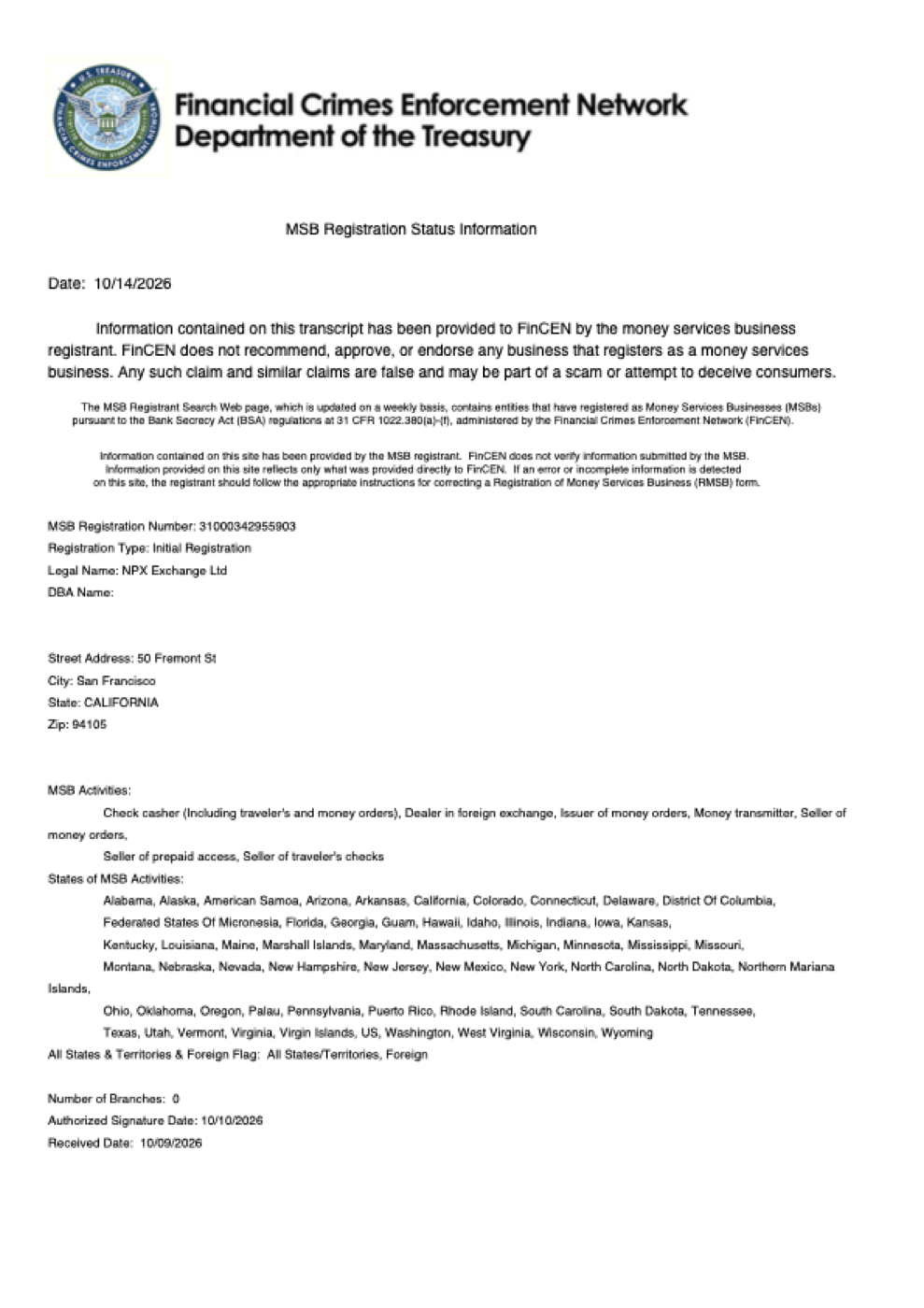
A site that presents this registration as an approval is therefore not making a small error of emphasis. It is asserting the opposite of the sentence printed on its own registration transcript. That gives a reader a simple test: when a claim and the document it cites disagree, the document wins. This is the standard the evidence file applies to all three records, and it is the reason the wording on this site is so exact.
06
What the registration does and does not carry
An MSB registration is worth something, and it is worth being clear about what. It locates a business inside a federal anti-money-laundering regime with defined duties. It creates a public record that a reader can find without asking the company for anything. It is a fact that can be checked. Those are real advantages over a claim that cannot be checked at all.
What it cannot carry is a judgement about safety. It says nothing about segregation of customer assets, nothing about capital, nothing about how withdrawals are processed, nothing about whether the business would survive a run. Those subjects belong to operational disclosures, and a reader who wants them has to look somewhere other than this record — for example at how the company describes its controls on the security site, or how it says withdrawals are handled on the reliability site. The verification walkthrough shows how to check the registration itself in FinCEN’s public search.
This registration proves
- A registration under 31 CFR 1022.380 exists for NPX Exchange Ltd.
- The registrant declared seven categories of activity.
- The record covers all states and territories and foreign activity.
It does not prove
- Any recommendation, approval or endorsement by FinCEN.
- Compliance with the Bank Secrecy Act in day-to-day operation.
- That customer funds are segregated, insured or safe.
- That any state has licensed the business to transmit money.